Mechanized Cellar
A kinetic tasting theater and classroom
In motionOne stack: crates ride a chain loop and stay level on their pivots. The app retrieval near the end shows the designed control layer, which was never built.
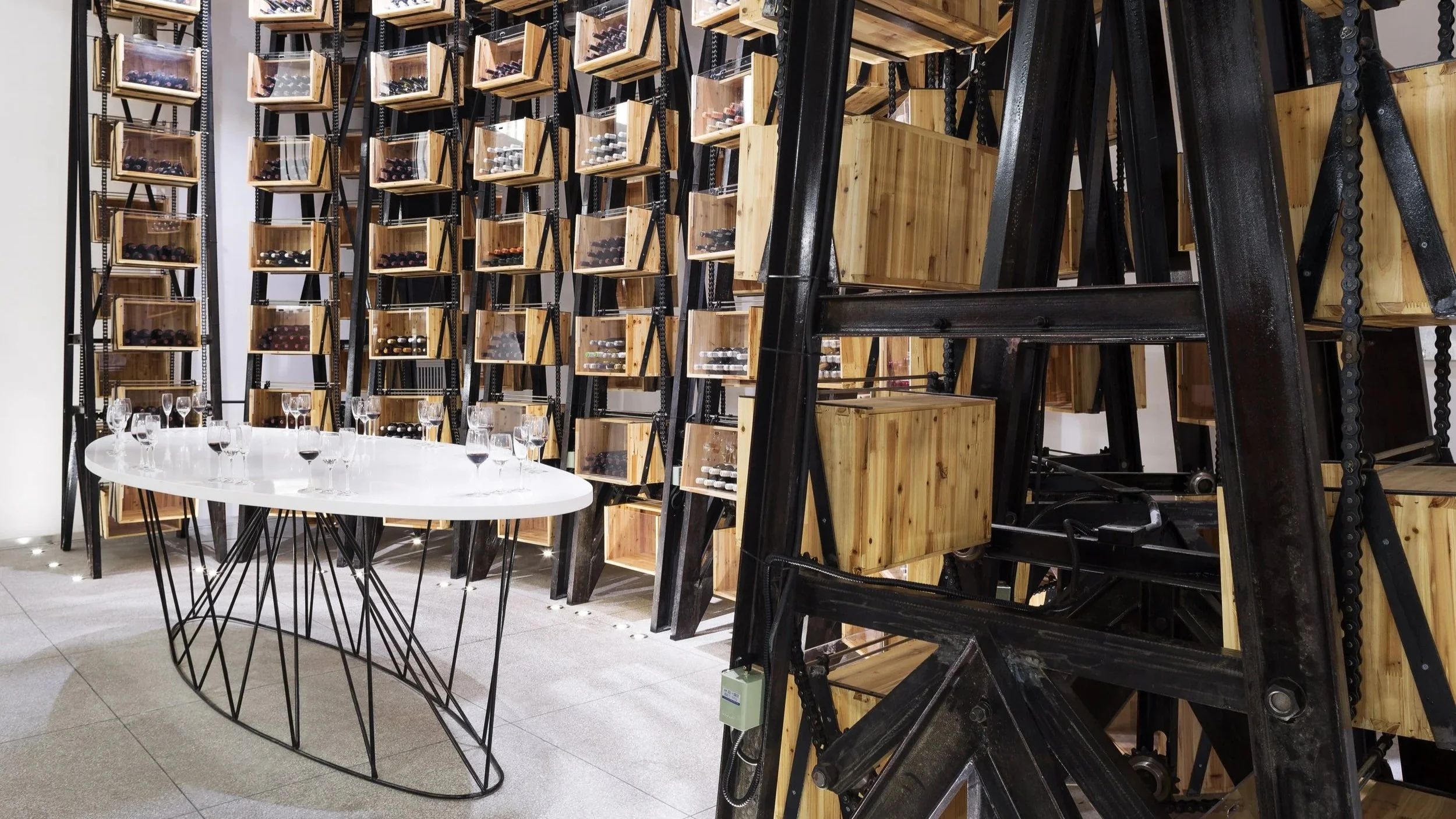
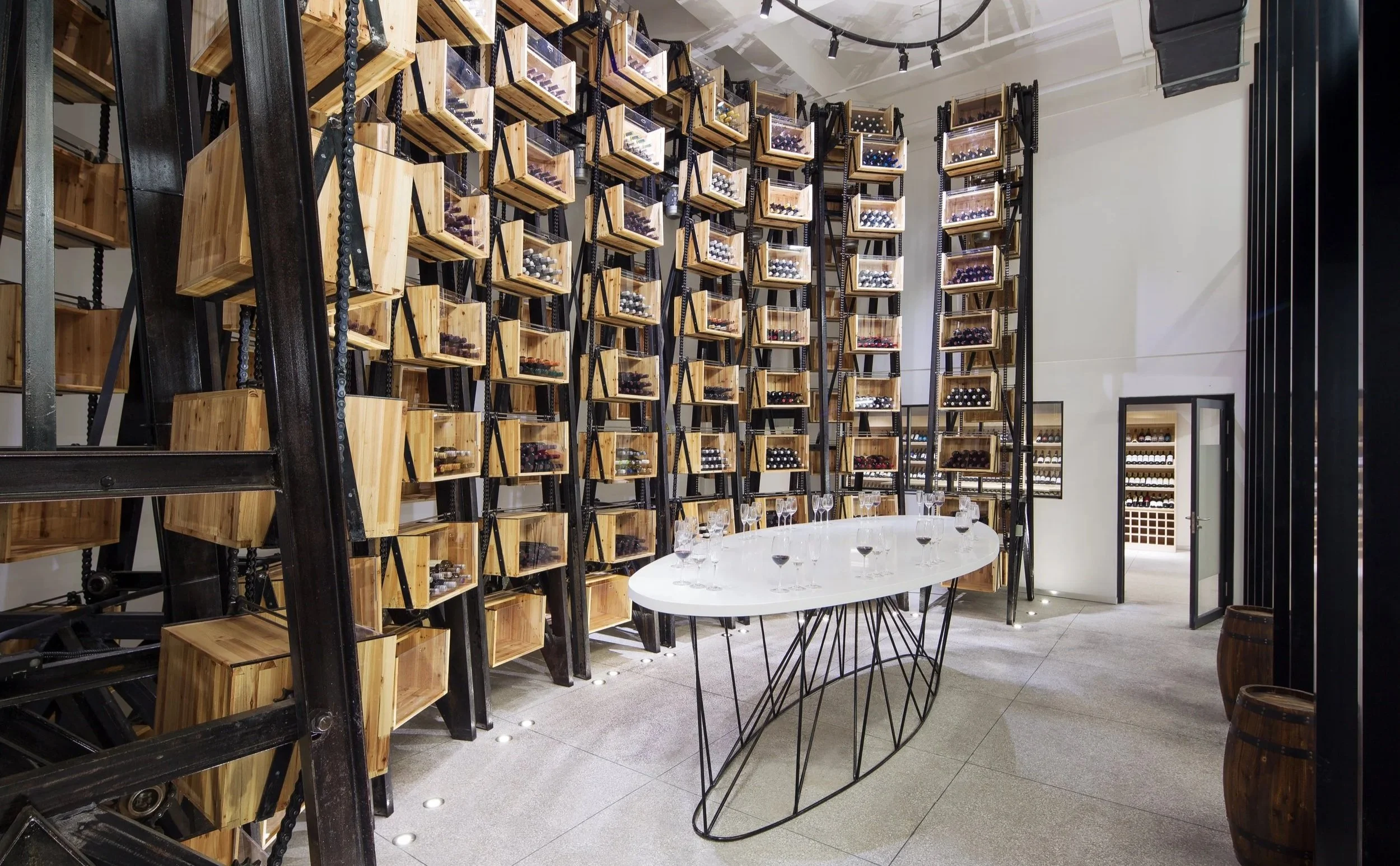
The Mechanized Cellar is a 60 m² (650 sf) teaching cellar for the PICH Culinary School outside Shanghai, built into the corner of a former gymnasium. Double-height revolving wine stacks splay in an arc around a custom tasting table that doubles as a projection surface.
The stacks are spatial actors: machines that reshape interaction with the wine and organization of space, rather than existing as idle storage shelves.
A project with constraints
The school board wanted a showcase cellar, on a budget of US$50 per square foot for design and construction combined. It came with four additional constraints.

Every room educates
Each space in the school had to serve its function and work as an active learning tool, the cellar included.
5,000 bottles, minimum
Wine from around the world, enough to cover most of the floor if stored traditionally.
No ladders, no open balconies
Safety regulations rule out climbing into the double height.
Honor the heritage
The college's industrial and technical history had to shape the design.
Inspired by Invention
“Standing alone inside my design for the Yue Garden Museum after the opening, I felt its still, inanimate quality: a sculptural environment framing moments in memory and photography. That realization marked a turning point. I wanted architecture that moved beyond the sculptural and static toward layered spatial experiences, where multiple actors, environmental, regulatory and technological, could operate simultaneously. What followed was the Mechanized Cellar, my first attempt to make that shift real.”


From static to kinetic
At PICH, the constraints of maximizing storage without ladders opened the way for a different kind of occupant: a mechanized system operating as a spatial actor rather than static storage.
Architects such as Leonardo da Vinci and Filippo Brunelleschi, who used invention to make their visions reality, have always inspired me. Leonardo’s chain studies in the Madrid Codex held a key to how these machines might operate.
Working directly with a fabricator, I developed and tested multiple prototypes. The challenge was not whether a machine could be built, but how to engineer rotation smoothly enough to protect the wine.
5.3 m of gentle motion
Each stack is a steel A-frame tower 5.3 m tall. A chain loop runs over two fixed half-star sprockets, and 24-bottle crates hang from pivots along it, so they stay level as they climb, cross the top and descend.
Each stack holds 552 bottles on a footprint barely larger than a square metre. Eleven stacks hold 6,072 bottles, more than 1,000 beyond the brief, and the floor stays open.


The digital stack
Every bottle carries an RFID tag. The stacks were designed to answer to an app over the internet of things: a student searches for a wine, the stack turns the right crate down to arm's reach by the shortest path, and the tag confirms the bottle before anyone touches it.
Designed systemHow a search would become a bottle in hand: app, cloud, on-site hub, stack controller, machine. Designed, not built.
A tasting table that is also a screen
At the center, an oval tasting table seats a full class of 16 to 20. A ceiling-mounted projector casts onto its surface, so students can read the true color of each wine in the glass while the lesson unfolds across the table.
From the second-floor gallery, visitors watch the class and the machines at once.


Delivering beyond the brief
Since 2015 the cellar has stored more than the brief asked for, with the floor free for teaching, tasting and tours.