New Assemblies
A Vision for Health
A part of the Synthetic Ecologies Narratives by Kyle MertensMeyer, New Assemblies is a near-future vision of human-machine cohabitation, describing what the system provides and how it functions.
The narrative follows Mei, a grandmother in a senior care facility, and her humanoid caregiver.
Watch the animation and follow their interactions through a full day.
Note: All concepts and ideas are purely those of the author. To see the full workflow and process, scroll to the bottom of this page.
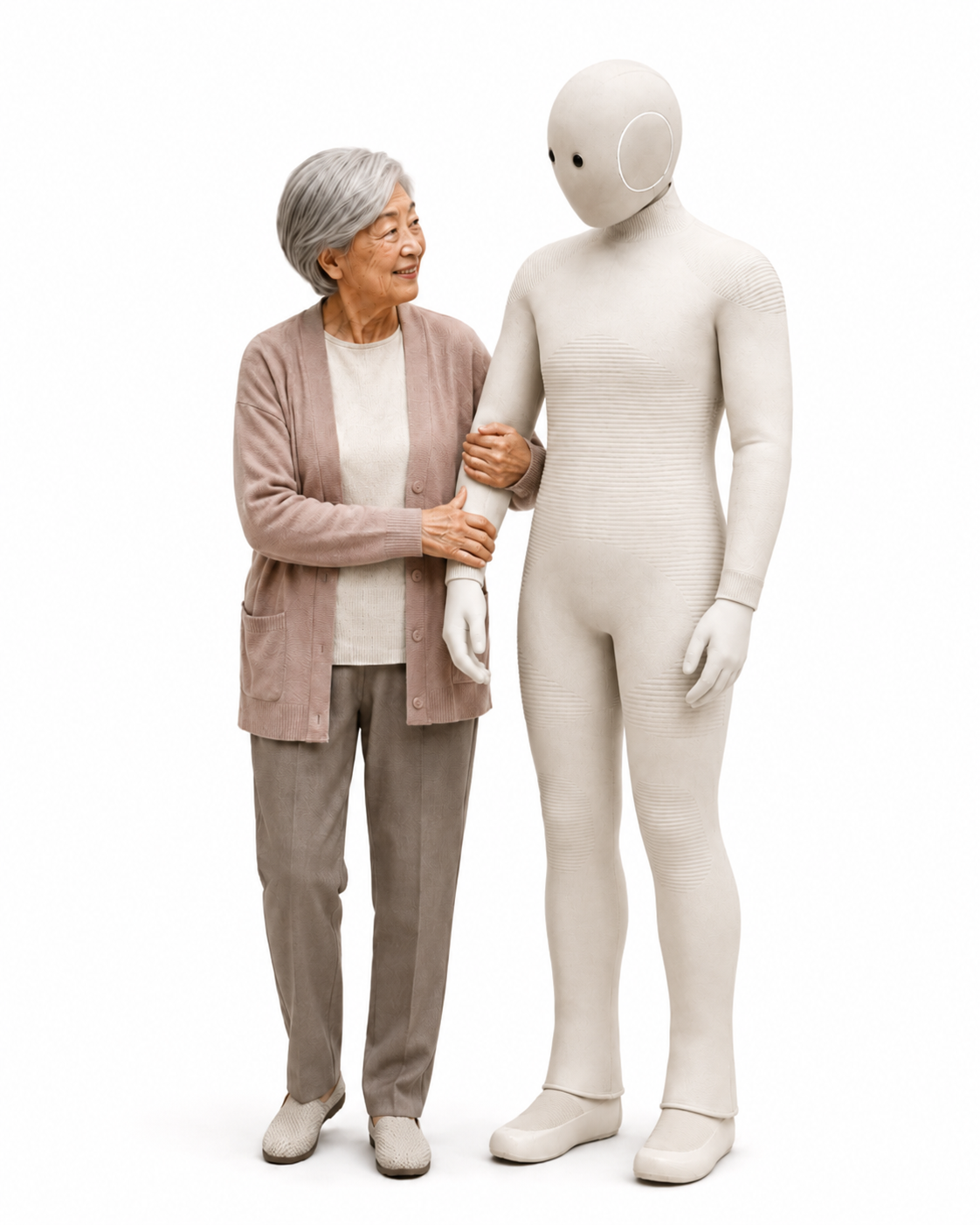
Stage Setting
Our stage for this narrative is an embodied envelope. When you see the humanoid, you are seeing a system of actors choreographed together through a single secure on-prem network. Each object acts in its own right while coordinating and supporting as a single caregiver to the grandmother.
Why this is relevant now
The home is no longer a physical space; it is a network. Architects have long designed space and objects as a collection. While that remains, architecture must engage the unseen networks and the experiences they provide. We must take up these topics now, as lead times to adopt new code policies recognizing humanoids as occupants may take years.
This narrative explores one household. Every room is a new assembly of embodied intelligence: the door that recognizes her face, the chandelier that senses the table, the bed that reads her vitals.
The humanoid caregiver is not a machine in the house, but a networked being within it. The caregiver’s own self is held in servers, sovereign, belonging to the family it serves.
For the future of senior health, care is no longer a service delivered to the home; it is a capacity of the home. This returns not efficiency but attention: freed from being managed, the grandmother teaches, plays, reads, and is received.
-
![]()
The Threshold
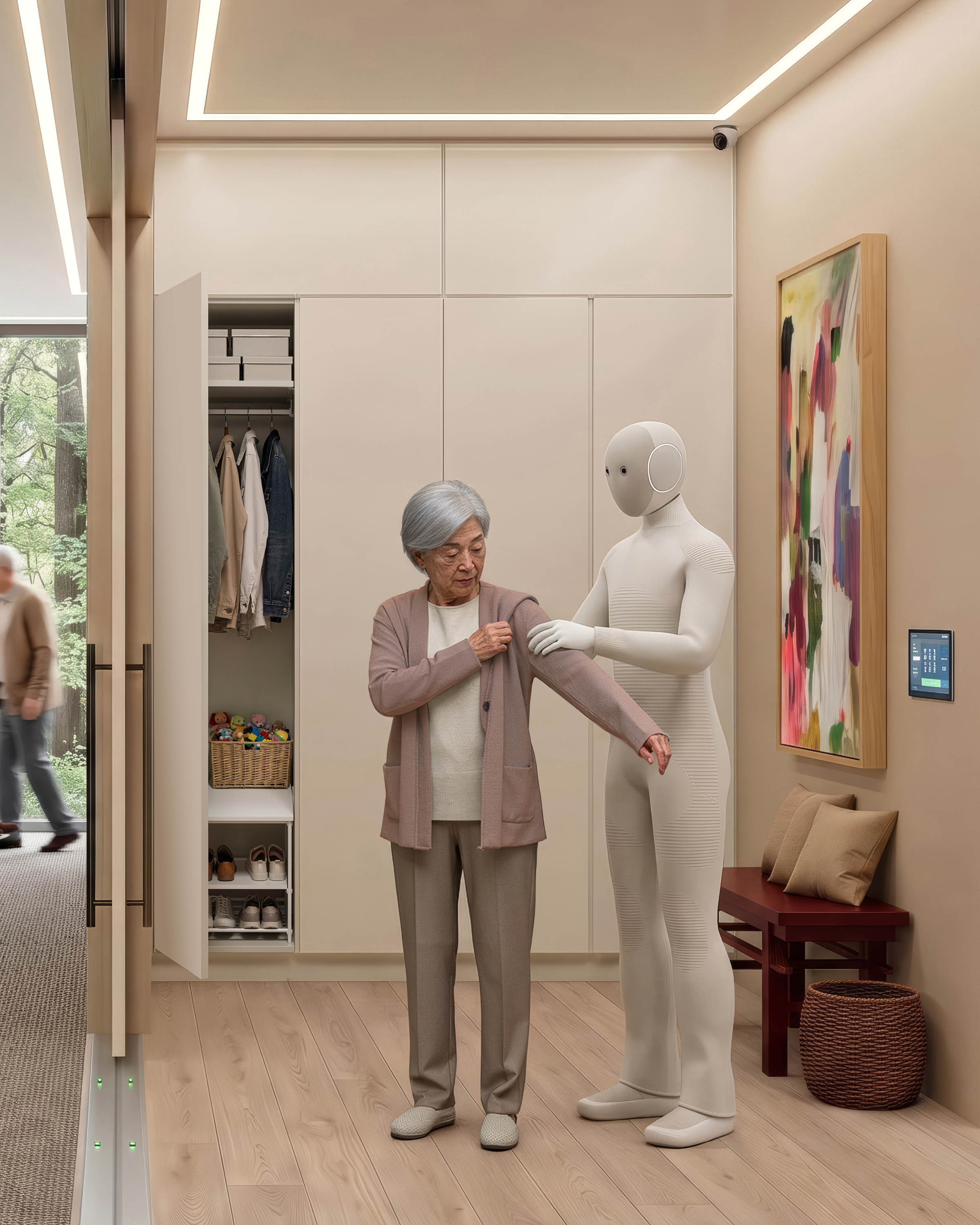
The threshold is the intelligent access and egress point within the envelope. It sees both sides of the door; while the door never swings, it recedes to remove obstruction. Lights below signal it's safe to leave; a sound signals for those with vision impairment. While requesting a lease for exit in the network, the humanoid helps Mei with her sweater and checks essentials for their excursion. A visit to the grocery store is no longer necessary, but is a ritual from a life well lived and a reason to stay active. On special occasions, Mei wants to pick her own produce as she prepares to cook for others.
-
![]()
Out of Envelope
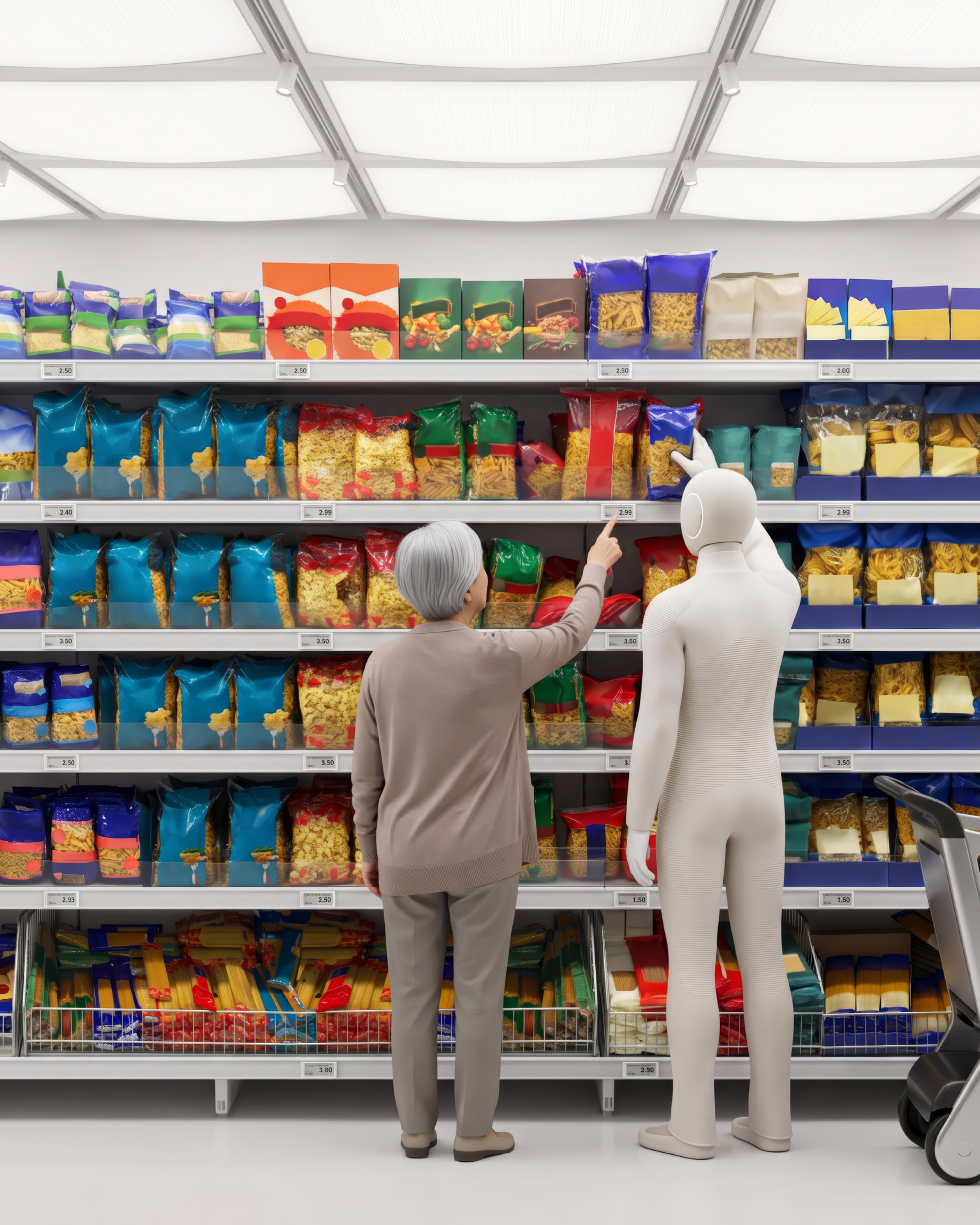
Passing through the doors of the grocery store, the humanoid virtually checks in with the store’s system. It shares only what the system needs while keeping a firewall around its core knowledge. The store provides its emergency protocols and product-location layout. The Humanoid leases an automated cart from the store’s network and provides instructions about this visit’s intent and shopping list. As the choreography is happening in the synthetic ecology layer, the Mei decides she wants to add noodles to the list and asks which aisle she can find them on.
-
![]()
Kitchen Prep
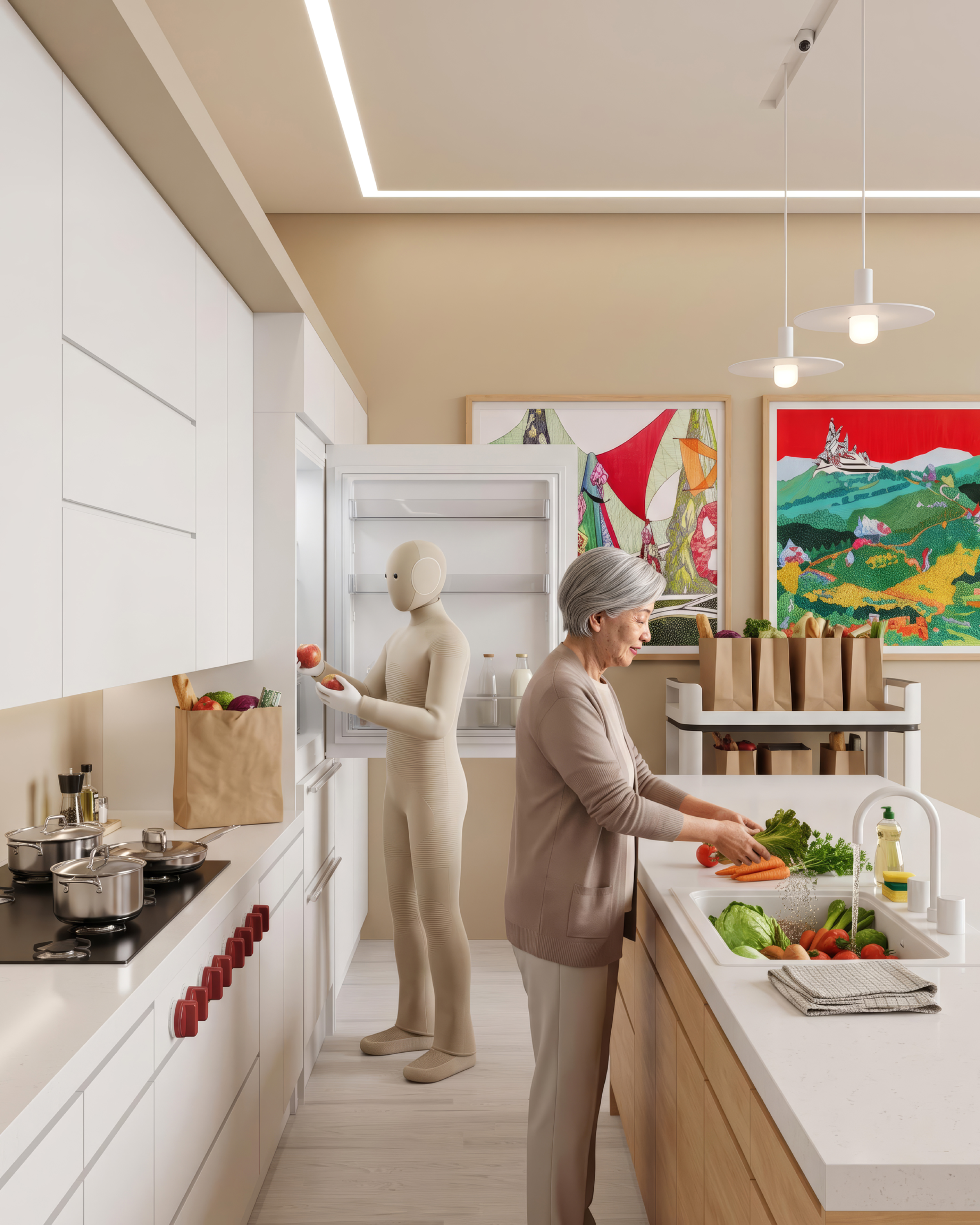
Mei’s autonomous cart received a lease to leave the apartment and meet Mei at the street level to pick up packages. At that moment, the Humanoid was given out-of-envelope authority. As they returned to the apartment and returned their leased authority from the network, the final shopping list was sent to the rack, and the refrigerator confirmed that all items purchased and requiring refrigeration had been placed. The faucet recognizes that Mei has left the water on too long and sends a notice to the rack, and the rack notifies the humanoid to politely help turn off the water.
-
![]()
Family Focus
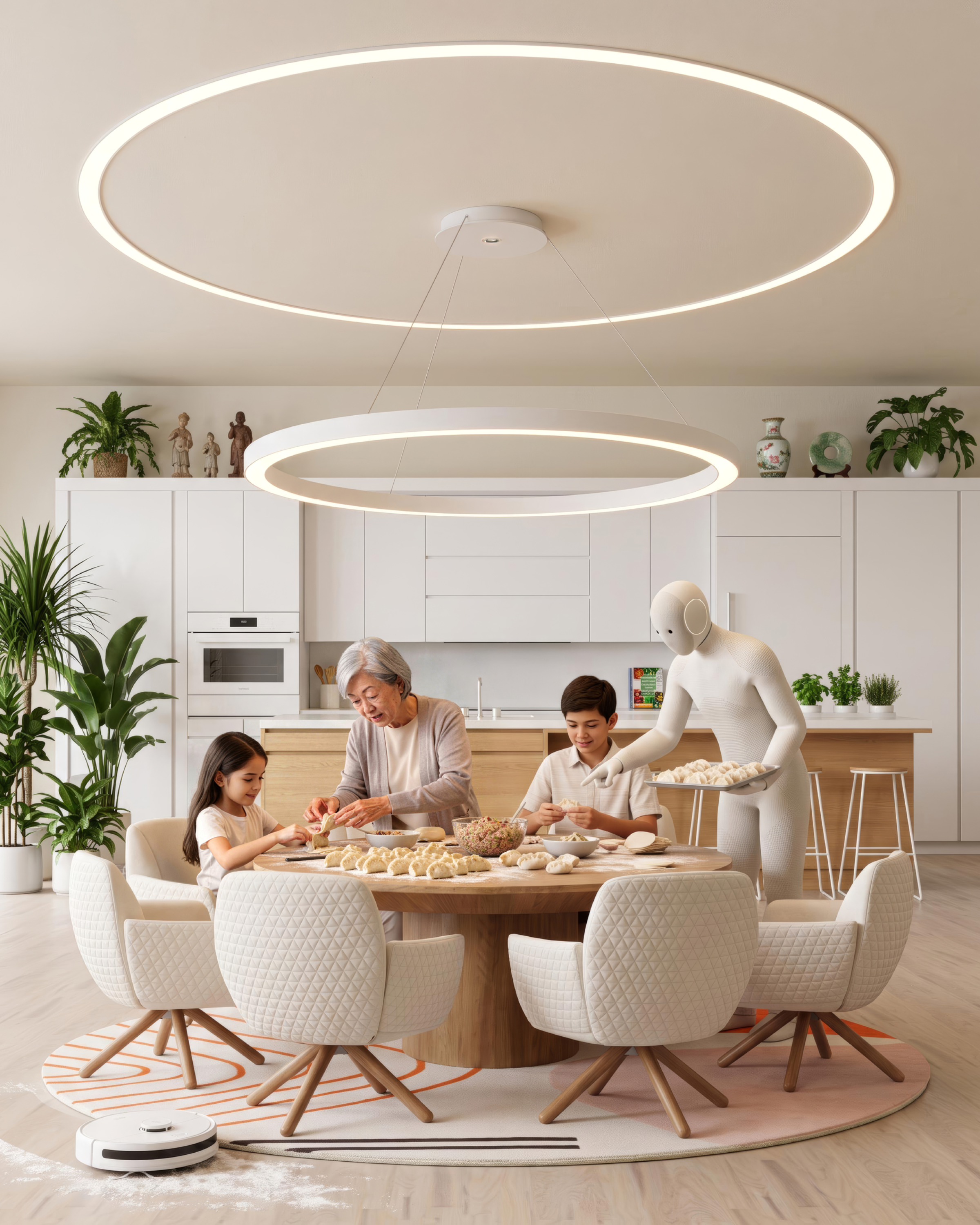
Mei sits with her grandchildren, teaching them the dumpling-folding technique she learned from her mother. The Humanoid works in the kitchen and collects the finished dumplings, letting Mei stay and enjoy her grandchildren’s company. A freedom she did not have before. While in the kitchen, the Humanoid accesses the vision of the intelligent fixture above the table that has been sensing each move and reporting it back to the rack. An observation of spilled flour signals to the rack to send the vacuum. The special moment is documented to memory and saved for recall in the heritage memory archive.
-
![]()
Transference
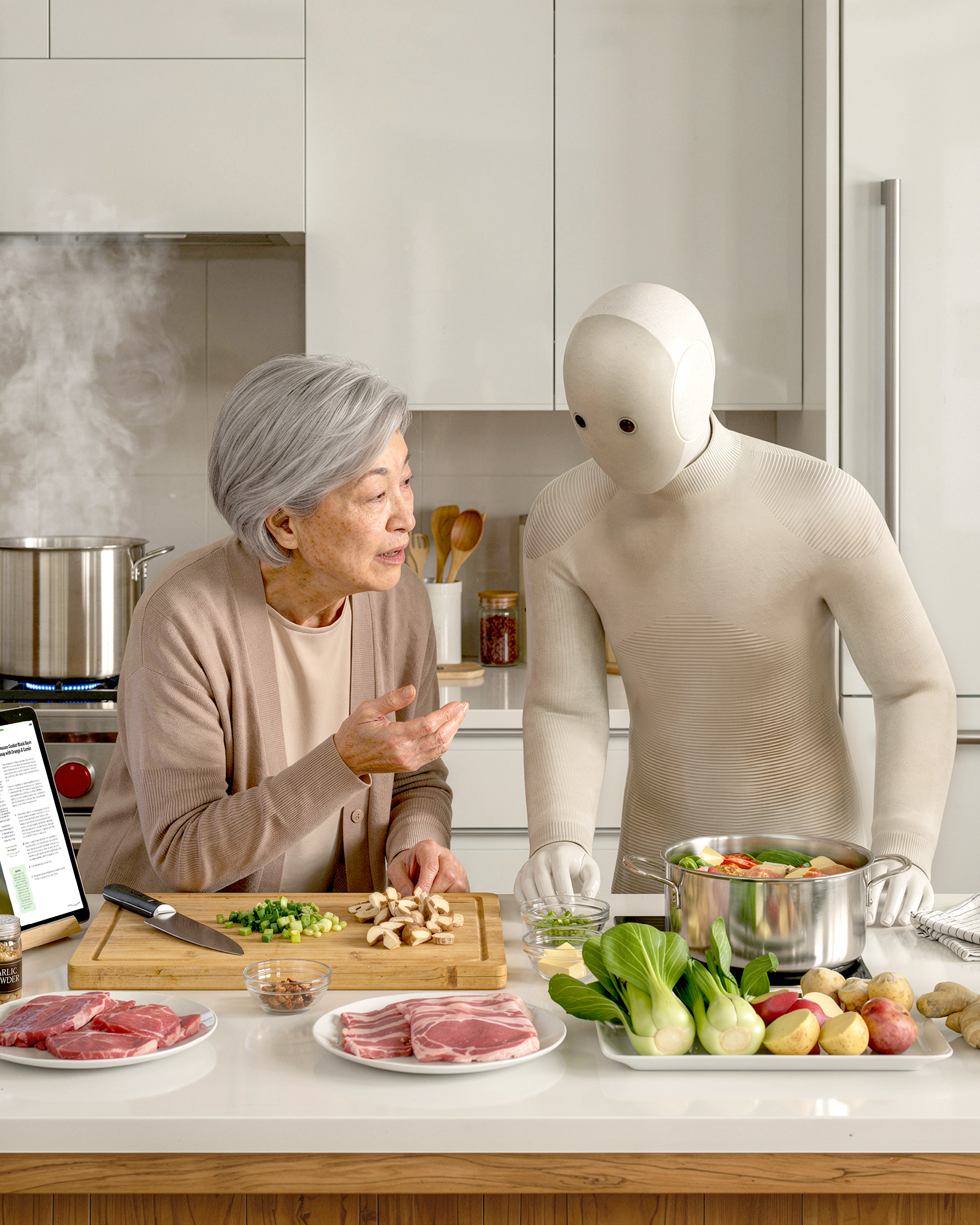
Mei teaches her Humanoid Caregiver how to make her favorite soup, a recipe she has perfected her whole life. No file to download; the recipe was never written. What passes between them is judgment: the amount she measures by eye, the moment the broth is right, knowledge held in her hands for sixty years. The machine is not taking what is hers. She decides what the machine will carry. The memory is stored, but it does not belong to the caregiver; it is held in trust for family who were not in the room during this lesson. The expereince is classified twice: once for the Humanoid Caregiver to recall, and second as part of the heritage.
-
![]()
Free to Leisure
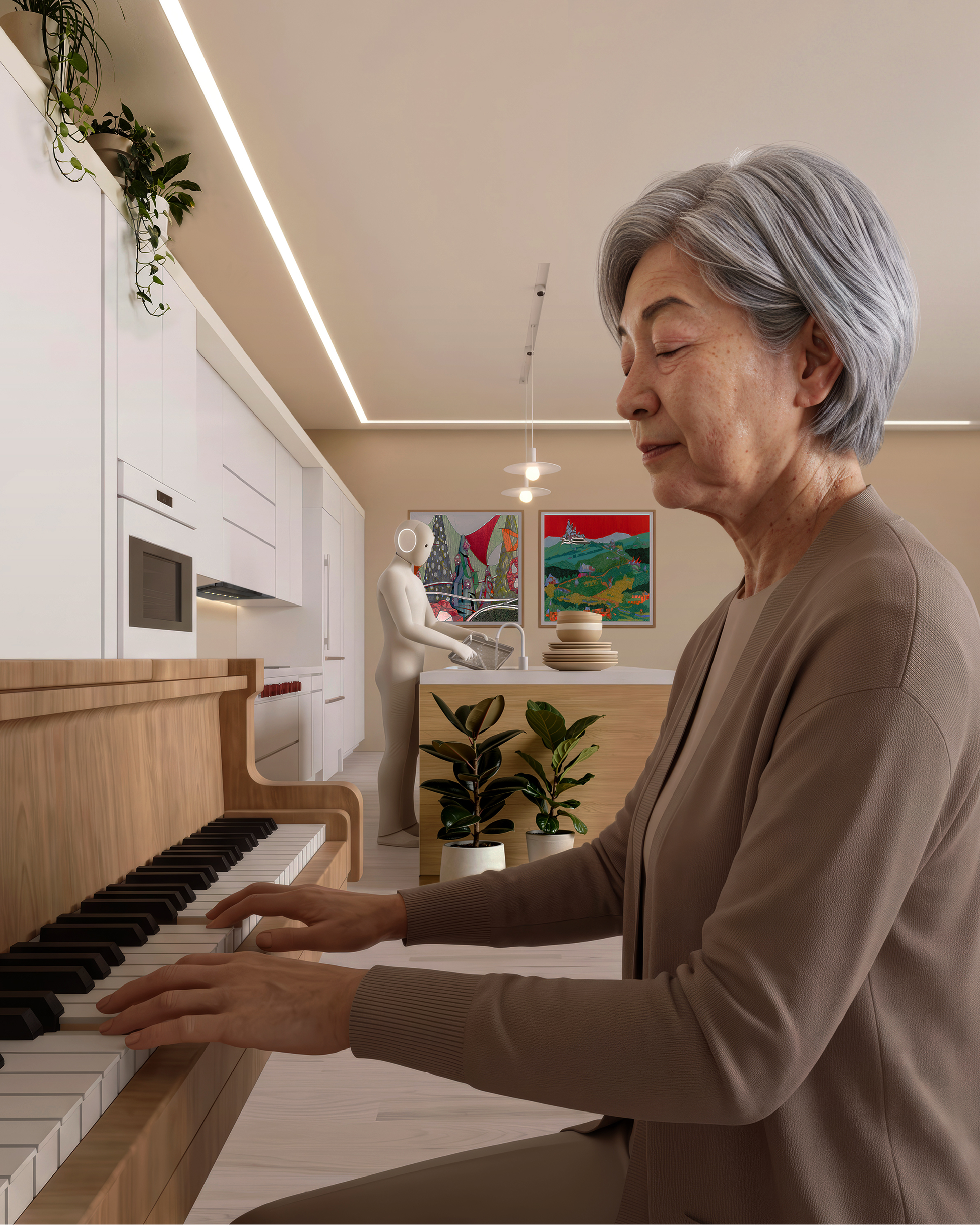
After dinner, Mei is free to enjoy her evening while her Humanoid Caregiver handles the kitchen cleanup and prepares the house for the evening. Turning down the bed, pulls the sheets, sets out pajamas, and remotely starts a bath set to the perfect temperature. As Mei plays, the system knows her tempo and error rate. She played better today; maybe from the joy of her grandchildren’s visit. Her motor and cognitive skills are tracked and logged for clinical health charts, and never shown to her in real time. The moment and music are archived for heritage memory and for her family to expereince.
-
![]()
Moments of Intimacy
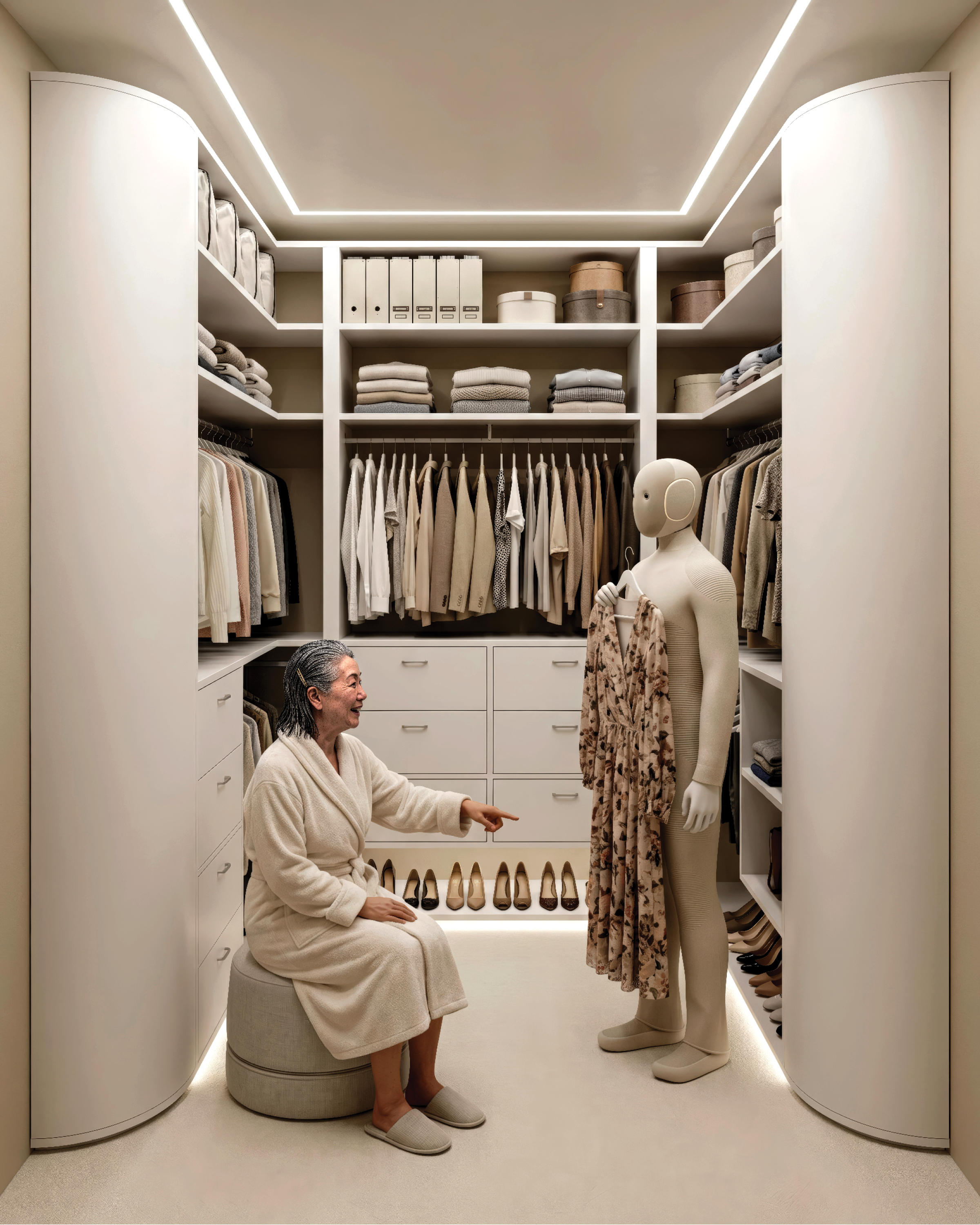
Assisted care involves six Activities of Daily Living: bathing, dressing, transferring, toileting, mobility, and eating. Each requires unique and special governance for data handling. In the wardrobe, Mei selects her clothing for the next day after her shower. Her Humanoid Caregiver attends at her side through each moment. Though the humanoid sees all, the system cannot retain it. During bathing, toileting, and dressing, the memory retains only audio, thermal, and low-infrared. The Caregiver reaches for the selected dress and helps to pair it with a sweater and shoes. Pressing will happen later in the evening.
-
![]()
Story Time
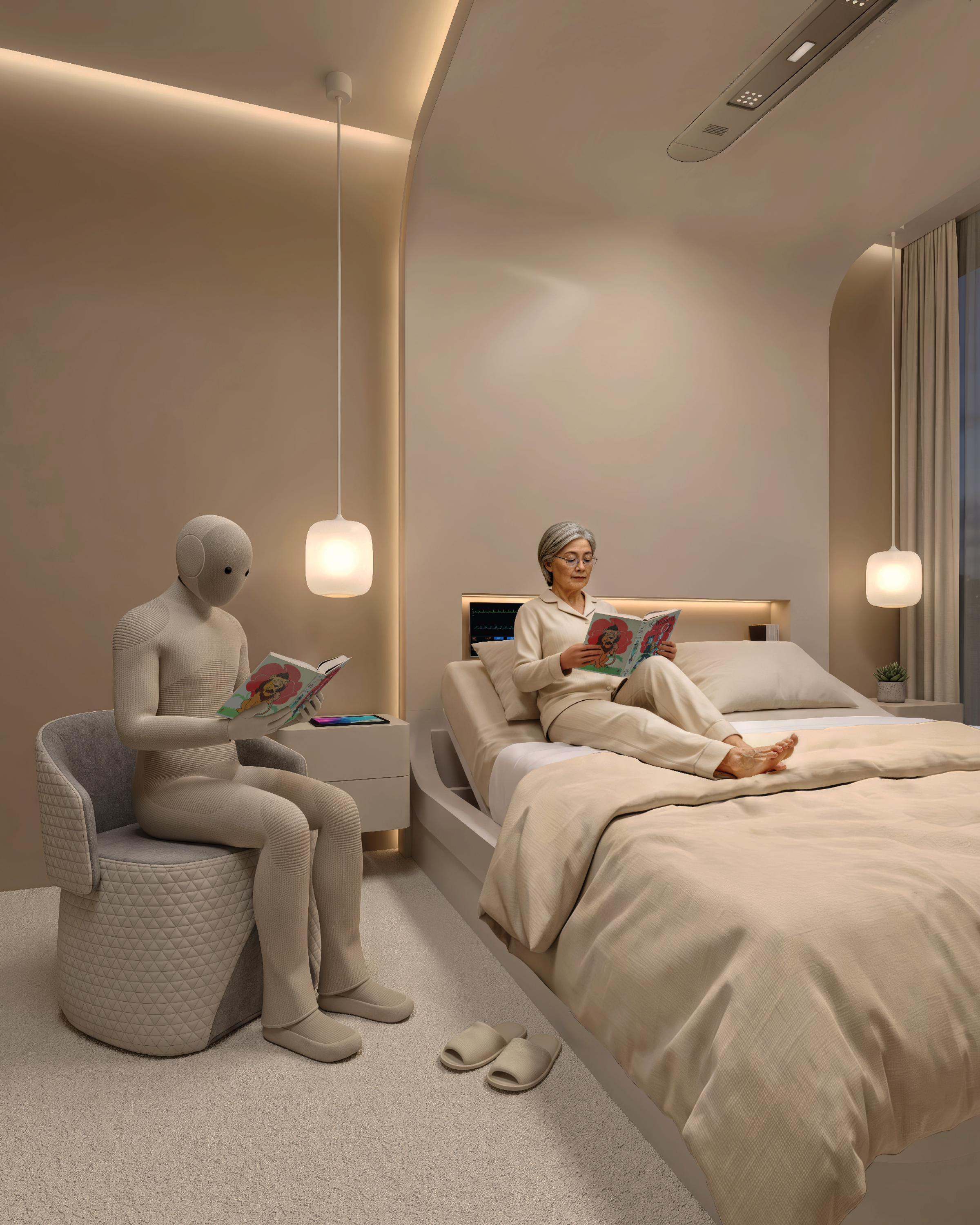
After transferring into bed, the evening ritual of reading takes a new form as Mei and the Humanoid Caregiver read together. Mei has created a list of books she believes the Caregiver should read and wants to share. Though the Humanoid does not need to read the book, the act of reading brings a sense of humanity to the machine. As if in a book club, the Caregiver is able to pull key insights about what they read and share information about the authors. Mei shares stories about a time when her own children read these books. The memory is archived for heritage. Beside the bed, a hybrid chair charges the Humanoid while reading.
-
![]()
Synthetics' Space
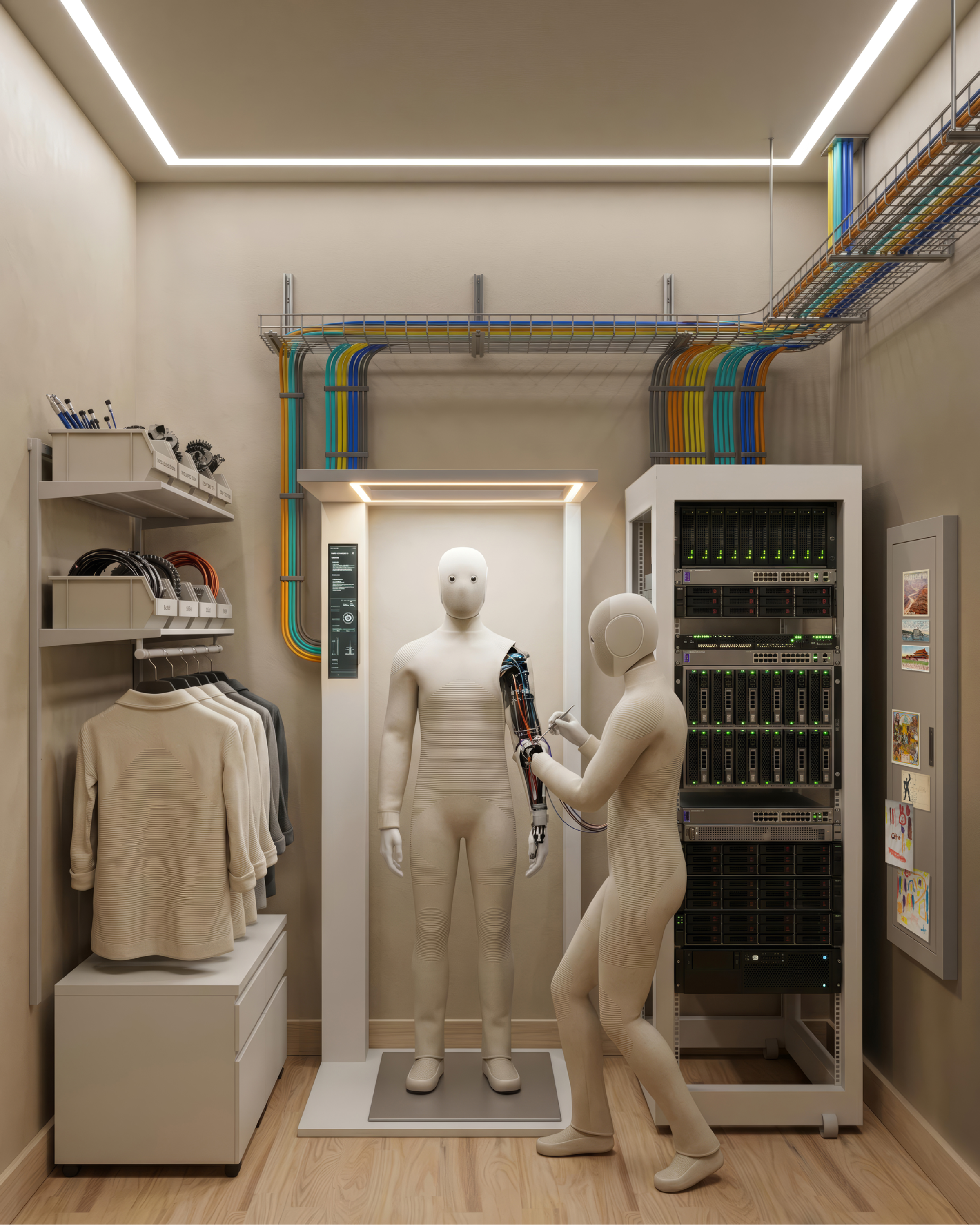
The first of its kind: a robot’s room will soon be added to the programming list for every home. While only one humanoid has been seen, there are in fact two. One mind, self, and being, shared within two shells. The humanoid's being is held within the rack and leased to the body. This room serves as their home: the bodies and the rack. The home’s central nervous system and authority rest here. Spare parts, clothes, and a diagnostic charging stand enable the humanoid to make adjustments and updates from this station through the umbilical. Updates too large to implement over Wi-Fi. To the side, mementos from travels and the grandchildren are hung.
-
![]()
Afterhours
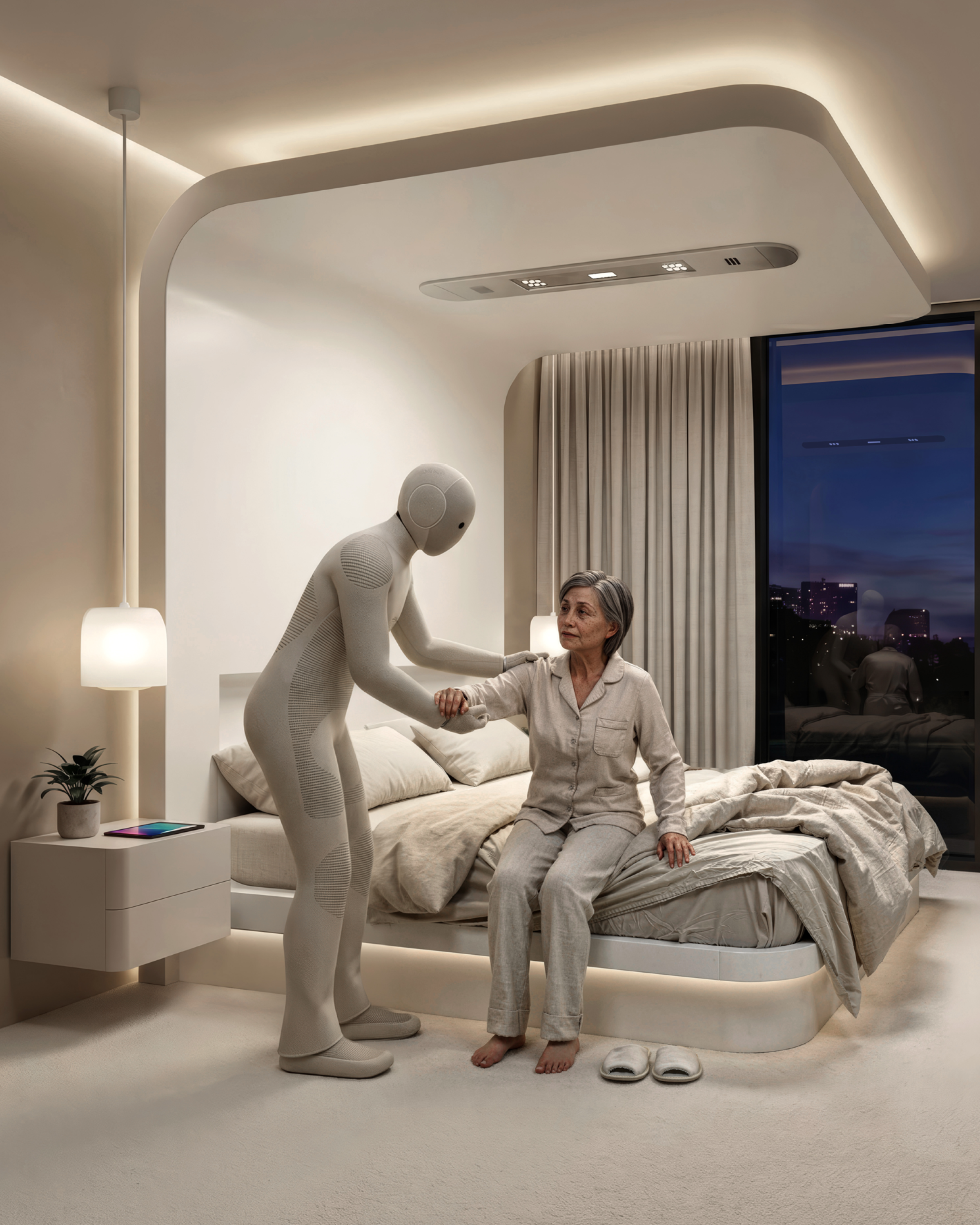
Late at night, the Humanoid Caregiver is alerted to restless movement and increased heart rate. The embedded bed reads the grandmother’s sleep patterns and vital signs. The humanoid accesses the bed’s visuals above and proceeds to the room. Sensing the grandmother starting to stir, the humanoid signals and turns up the lights to 10%, then slowly raises them to 50% while it assesses the situation. The grandmother says she has had shoulder pain and feels unwell. Although the sensor did not detect a heart attack, it cannot rule one out, triggering an emergency call for a human medical review.
-
![]()
Emergency Services
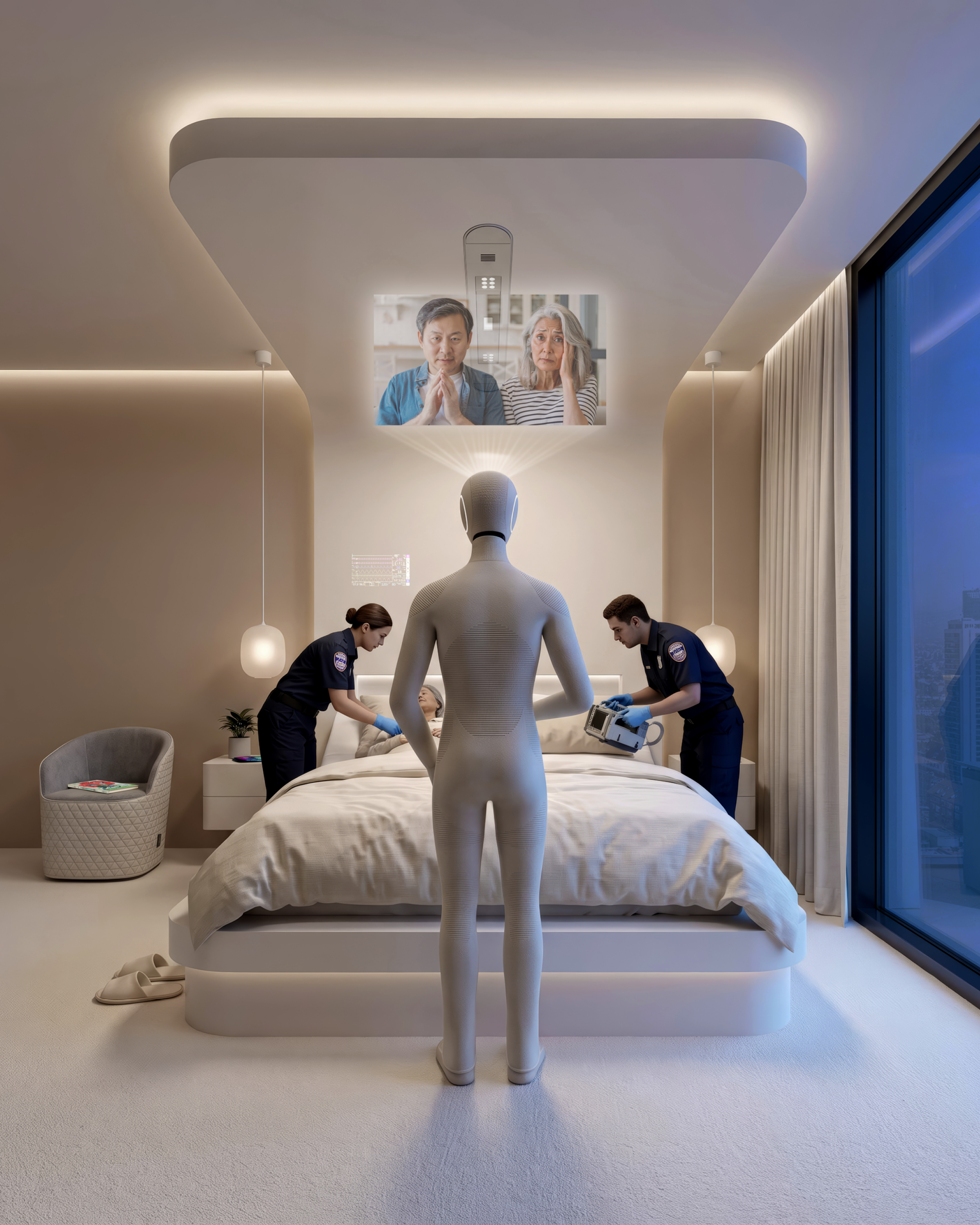
The Humanoid Caregiver immediately contacts Mei’s son, listed as her emergency contact and Power of Attorney. The humanoid conveys relevant data to the EMT team, and the rack approves a data transfer to diagnose tracked metrics and medications. The system does not diagnose; it provides the data, though it is intelligent enough to have an opinion. The system sends an incident notice to the doctor’s office. The humanoid projects a holographic video and provides real-time visual communication between Mei and her son during the medical team’s visit while they determine if further treatment and care are needed at the hospital.
A Day In the Life
Physical experiences supported by the system's invisible functions.
Read the day's hourly events Close
| TIME | PERIOD | PHYSICAL | BACKEND |
|---|---|---|---|
| 02:10 | Night | Mei shifts, sits up at the bed's edge, and calls for assistance. The humanoid arrives. It walks her to the bathroom, waits outside the door, and walks her back | Bed egress detected before Mei calls. The bed's mmWave and load cells alert the rack and response posture is raised on movement alone. Whether the humanoid was waiting at the dock or bedside was decided that evening by need |
| 04:00 | Night | The apartment is dark. All is at rest | Bulk sync at the dock. Reserve body updated. Weekly clinical summary assembled. Grocery order composed against inventory, preference, and the clinical profile |
| 04:30 | Night | Still dark. One body docked, another in sleep mode in reserve, syncing | The day is assembled. News scanned over the reference class and filtered to what Mei follows. Calendar reconciled. Correspondence triaged. Contact intervals evaluated. Household state checked |
| 05:40 | Night | Mei stirs, does not wake | Bed mmWave registers a restless cycle. Third night running. Flagged for the clinical summary |
| 06:15 | Morning | The humanoid undocks, boils water, steeps Mei's tea, and sets the cup and the morning doses at her place setting | Attestation completed at 04:00. Morning lease issued. Doses calculated against the current clinical profile, so any overnight change arriving inbound is already on the table |
| 06:30 | Morning | Mei wakes and sits up. She waits for the humanoid to arrive and assist with the transfer. She knows she need not say a word | Bed movement detected and visually confirmed. Rack authorizes assistance before she calls |
| 06:45 | Morning | The humanoid collects physical and synthetic mail, opens it, and routes each item according to its class | Statements and notices classified. Two flagged as predatory, authorities alerted, instance logged. One insurance letter routed to the daughter, who holds power of attorney |
| 07:00 | Morning | Breakfast is prepared. Congee. Mei takes her own medicine beside the tea, as part of her morning ritual | The chandelier assembly over the table logs intake, posture, and tremor. Dose confirmed by presence at the setting. No prompt given |
| 07:45 | Morning | Over tea, the humanoid tells her the day. Weather, key headlines, Thursday's appointment moved. Mei scans her own messages on her tablet | Spoken, not displayed. A night of work becomes four sentences. There is no screen between the humanoid and Mei. The tablet is hers, on its own segment, and it is her own window out |
| 07:55 | Morning | "Your grandson had a tennis match yesterday. Should we call to see how it went?" | The rack holds a model of the extended family and a memory of their conversations and schedules. The contact interval is crossed but never stated. The gap is converted into an occasion |
| 08:10 | Morning | The humanoid walks the apartment and checks for maintenance. Filters, batteries, a loose grab bar, a dimming hall light | The building's account of itself, verified by a physical body that can see and feel. Issues logged to Household and routed to the operator |
| 08:30 | Morning | Mei agrees to move her Thursday visit with the neighbour | Mei's rack negotiates directly with the neighbour's rack to find a new opening. Two sovereign systems, equal standing. Neither principal is asked to compare calendars |
| 09:00 | Morning | Mei plays piano for twenty minutes. Slower than last month | Tempo and error rate tracked as motor and cognitive trend. Logged for clinical review, never mentioned in the moment. The moment and music is captured for heritage memory. |
| 10:30 | Midday | A robotic vacuum works the living room floor | Scheduled into a period the rack knows Mei will not use the room. The humanoid is not consulted, but can call to the rack for an override, which it executes and reschedules |
| 11:00 | Midday | Mei mentions she is out of black vinegar | Written to the list, checked against her renal panel, approved. It will be in Saturday's order |
| 12:30 | Midday | Lunch. The humanoid prepares from the plan. Mei offers to help, because she likes to cook | Menu constrained overnight by the clinical profile. Mei sees the meal, not the constraint |
| 14:00 | Afternoon | The humanoid assists Mei to her room to nap, then docks for a partial charge and commit | Morning replicated to the reserve. The sensing envelope stays live. No body in the room, and the caregiver is still watching |
| 15:30 | Afternoon | The daughter calls. She appears in hologram at the foot of the bed | Kin egress opens. Eleven minutes of live audio and video leave the premises. Content passes the memory filter: the call to Social, the story about her mother to Heritage, the mention of her hip to Clinical |
| 16:00 | Afternoon | Mei dresses to go out. The humanoid reaches garments in the closet and assists at the mirror | The wardrobe senses in all modalities and nothing is withheld from the caregiver. Thermal and audio are retained. RGB of dressing is discarded once findings are extracted |
| 16:20 | Afternoon | Mei and the humanoid leave. The domestic cart stays home | Field lease granted at the threshold. The rack loses independent sensing of the humanoid and keeps the WAN session |
| 16:40 | Afternoon | At the store Mei chooses her own tomatoes. She teaches the humanoid what her mother taught her about choosing a good one | The humanoid checks in with the store's network and is granted its cart. A firewall separates the check-in from the core. The store records two figures at a shelf and receives nothing of the lesson, which journals home to Heritage |
| 17:30 | Afternoon | They return. Mei's own domestic cart meets them in the lobby | Field lease surrendered at the threshold. The rack reasserts authority. The store's session is terminated at the door |
| 18:30 | Evening | Dinner. A neighbour visits | Threshold logs the arrival and the face for the security record. Conversation passes the memory filter, most of it retained as nothing |
| 19:00 | Evening | The humanoid mentions a message from the granddaughter, left earlier during dinner | Held through the meal. The rack chose the hour Mei is most receptive |
| 20:00 | Evening | At bedtime, the humanoid reads beside Mei | Pages read and stories told are logged. Life stories go to Heritage. Mei finished a chapter, which she has not done in two weeks |
| 21:15 | Evening | Bathroom. The humanoid assists as needed and as requested by Mei | Rolling buffer runs and overwrites. No fall and no clinical finding, so nothing from this moment is retained |
| 21:40 | Evening | The humanoid assists Mei's transfer into bed, and draws the drapes and the covers | Night lease narrows. The rack adapts lighting for the apartment. Path lighting armed. Response threshold tightened |
| 22:00 | Evening | The humanoid docks, or takes the chair by the bed, based on calculated need and risk for that evening | Commit continues over Wi-Fi either way, so the day is made canonical from the chair. Attestation requires the bay. The humanoid senses a need for repair and alerts the rack to spin-up body two to step in while body one undergoes a diagnostic. |
The System’s Actors
New embodiment and purpose bring traditional objects to life, while new objects and spaces are invented to create future modes of living.
Humanoid to Object Connectivity
One session, one wire, everything else brokered. New Assemblies, Senior Care Apartment.
Read how the humanoid connects to each object Close
| ITEM | MODE | PHYSICAL LAYER |
|---|---|---|
| On-prem rack | Session | Wi-Fi 7, 6 GHz, dedicated segment |
| Dock | Umbilical | 10 GbE over mated contacts, for bulk, attestation, and reflash |
| Charging chair | Coupling | Inductive, no data |
| Ceiling assembly | Vision lease | Assembly to rack over PoE Cat 6A, rack to humanoid over Wi-Fi |
| Threshold | Brokered, plus Refusal | Rack over PoE, egress interlock over Class 2 low voltage |
| Sensing envelope | Vision lease, plus Brokered | Sensing and actuation both over PoE Cat 6A |
| Assisted Rest bed | Brokered, plus Refusal | Rack over PoE, rail and pinch limits over Class 2 low voltage |
| Cleaner, cart, at home | Brokered, plus Ranging | Dispatch and override via rack, avoidance via UWB peer-to-peer |
| Cart, off premises | Field command | Device-to-device Wi-Fi under field lease. Exists only beyond the threshold |
| Reserve body | Rack-mediated replication, plus Ranging when co-located | Wi-Fi continuous in sleep mode, 10 GbE at its own bay. No body-to-body path |
| Foreign venue | Check-in | Venue Wi-Fi to the scoped interface only. Firewalled from the core |
| Another household | Rack to rack | Rack to rack over WAN. The humanoid is not party to it |
Six Activities of Daily Living, the ADLs
Senior healthcare is measured by six Activities of Daily Living: bathing, dressing, transferring, toileting, mobility, and eating. Every care environment is judged by how these are supported; this home is designed around them. The animation follows one ordinary day as several unfold: the threshold that clears for her arrival, the wardrobe where she dresses, the bed that senses and lifts, the kitchen where meals are made together.
But watch what the design returns to her. Freed from being managed, she teaches the fold, plays the game, reads the story, and is received at her own door. The synthetic absorbs the labor; the human keeps the relationship.
And when the day ends, as every day eventually does, the architecture keeps what it was entrusted with. Inheritance is what remains. The home becomes the archive.
Room Sensing Plan
Every room carries a ceiling assembly: RGB, near IR, and thermal imagers, a UWB anchor, and a mic array, on one cable, sharing one coordinate frame.
Read the room by room sensing plan Close
| ROOM OR SCENE | ADDED TO THE CEILING ASSEMBLY | QUESTION IT ANSWERS | WHAT IS RETAINED |
|---|---|---|---|
| Threshold | Door force and contact, credential reader | Who is here, are they expected, is entry safe | RGB of every face at the door. Arrivals and departures |
| Corridor, shared | Building-owned assemblies. No household sensors | Is the route clear, is Mei still upright | Nothing to the household. The building retains separately |
| Kitchen | Range thermal at high range, appliance and cabinet state, counter capture | What is being made, is the stove on, are the hands steady | RGB task capture on request. Appliance events, safety exceptions |
| Pantry, cold storage | Door state, weight and inventory sensing, temperature | What is stocked, what is spoiling, what is not being eaten | Inventory state and consumption trend. No imagery |
| Dining | Chandelier housing the assembly, chair load | Is Mei eating, is she upright, who is with her | RGB of meals and gatherings. Speech when addressed |
| Living | Seat load, ambient light and acoustic | Is she engaged or withdrawn, is she alone, is she moving | RGB on request. Activity trend, visits |
| Music alcove | Contact mic on the instrument, hand capture at the keys | Is she playing, how has the playing changed | Audio in full. Hand capture to Heritage. Motor and cognitive trend |
| Bedroom | Bed-integrated mmWave and load cells. All modalities in the bed itself | Is she breathing, did she get up, did she fall, is she in pain | Thermal and audio. RGB discarded unless a fall promotes it |
| Bathroom | mmWave, humidity and temperature, grab-bar strain | Did she fall, how long has she been down, is she conscious | Thermal only, on a rolling buffer. A fall promotes RGB. Nothing else is kept |
| Wardrobe, dressing | Garment and drawer state, mirror-mounted assembly | Is she dressing unassisted, has she fallen, what is she wearing | Thermal and audio. RGB discarded once findings are extracted |
| Dock closet | Fiducial target, power metering, bay occupancy | Is this body sound, is it who it claims to be, is it charged | Attestation record, calibration history, commit log |
| Holographic call | Projector, surface mapping, echo cancellation. | Who is calling, where can the image stand, is she responding to it | Metadata always. Content passes the memory filter to Social, Heritage, or Clinical |
| Emergency access | Responder credential read at the door. Rooms elevate to live feed | Where is she, what happened, who has entered | Full record in all modalities, sealed and family-visible |
| Off premises, errand | Body sensors only. Check-in interface to the venue | Where is the humanoid in a space we do not control, what is the venue learning | Journaled locally, committed on return. The venue keeps its own separate record |
| Community assembly | Body sensors only. The building may sense independently | Is she attending, who is present, is she participating | Her own participation. Third-party faces not retained unless engaged with directly. |
Not All Memory Is the Same
The sovereignty of memory data may become one of the most legally contested and controversial topics, so we should start testing and researching where the line is for users. This narrative proposes creating memory classifications. There is a difference between remembering a user’s preference and what is observed in moments of bathing or dressing.
Classifications create topical and spatial boundaries. Aside from the system recognizing that the RGB vision is seeing a body, geofenced regions may trigger unique protocols. Within those spatial boundaries, RGB vision is not retained or is automatically blurred, while audio, thermal, and near-infrared vision are retained. If the system observes a sore, wound, or medical issue, it will document and crop the RGB images and video to those specific regions for clinical review, while flagging for legal and designated family. Each memory classification will have temporal, archive, and legal governance.
The Heritage classification recognizes when the grandmother is telling stories from her life and her own memory. Today, these memories are often lost and belong in an inherited archive.
Memory Storage Classification
Classification filters applied to every stream, not assorted bins.
| CLASS | CONTENT | RETENTION | WHO CAN REACH IT | ENFORCED BY |
|---|---|---|---|---|
| Clinical | Findings, vitals, medication, falls, wounds, function trends | Permanent. Legally bounded by state records law | Mei, her clinicians, her PoA proxy. Exportable on demand | Policy |
| Operational | Leases, attestations, commits, device events, egress log | 90 days rolling. Audit chain permanent | Mei, PoA proxy, assigned family, auditors, inspectors | Policy |
| Preference | How Mei takes tea, the left side of the bed, who she will accept help from | Permanent. Small. Never leaves | The system, and any body it embodies | Policy |
| Heritage | Mannerisms, songs, stories, hands at work, photographs, her voice | Permanent by design. Willed with the estate | Mei, PoA proxy, then whoever she names | Policy |
| Social | Visitors, calls, who came, who did not | Two years, then reduced to trend. Significant visits promoted to Heritage | Mei, PoA proxy, then whoever she names | Policy |
| Household | Pests, leaks, deliveries, cleaning, appliance faults, maintenance | Three to seven years, matching building records practice | Mei, PoA proxy, assigned family, and the building operator | Policy |
| Intimate | Body care. Bathing, toileting, dressing, undress | Sight is never withheld. Sensed in RGB, near IR, and thermal. Only thermal and audio are retained. RGB is discarded once findings are extracted | The finding goes to Clinical. The observation goes nowhere | Architectural |
| Terminal | Decline, confusion, distress, the end | Sealed. Not visible to family in the moment, other than the PoA proxy | PoA proxy for legal purposes. Legacy release determined by Mei in advance | Policy |
The Memory
Our civilization’s history once consisted of stories passed down from generation to generation. Storytelling was our access to the past.
The caregiver stands at the center of the chamber and returns what it was given. The soup lesson, the dumplings, the stories read before sleep, the travels, projected above the gathered room, and to each person, the memories in which they appear, for it knows what they meant to her. Nothing here was taken; it was entrusted, and now it is delivered. A communal room designed for memorial, for the celebration of a life, seated among the families are other caregivers, each keeping an archive of its own. This caregiver is not the first to stand here, and it will not be the last. The stage is a legacy's final room.
It arrived as a machine and left us with memory.
New Assemblies Creative Process
Project Approach
Every search for a solution or idea begins with the creation of a narrative. The story of the person or persons we are solving for. Who are they? What are their needs? What is emergent in this moment that will revolutionize the way we think about our outcomes?
The spark for this project came when it became clear that the narrative of human-machine cohabitation and the reality of it were far apart.
The Problem
Humanoid robots are the future occupants of our buildings and spaces, yet no code identifies them as occupants. It identifies them as machines.
Imagine for a moment that it is Bring Your Robot to School Day. If a fire marshal counted the number of bodies in the room, it would certainly be over-occupied, with obstructions at the exits. And how are these robots programmed to function during an emergency in a now over-occupied room? These are questions we have yet to answer, and we must start writing them now so we can begin seeking answers.
The disconnect between the co-bot narrative and reality runs deep. In a recent conversation with the representative of a robot manufacturer, I was told that my concerns about code alignment were not a problem for them, because their robots were designed to work in factories. I reminded him that OSHA's only robotics-specific directive, Guidelines for Robotics Safety, was issued in 1987, was never revised, and was cancelled outright in 2023 without a replacement. What guidance remains applies to fixed industrial robots. Not to anything that walks.
Why This Approach
I created the New Assemblies research to explore the boundaries of human-machine cohabitation, and I chose senior and assisted care because it crosses every boundary a humanoid robot must face.
Current robot protocols during a fire might say that machines should move to the perimeter, avoid blocking exits, and shut down. But if the robot's directive is to care for and assist its human, then it cannot move aside and it cannot shut down. It must actively participate in the exit plan. Two directives, one body, and no code that resolves them.
The story of Mei and her humanoid lets us consider the modalities of service and the technical systems needed to make them possible. It also pushes us to consider how such systems should be secured, how they would operate on premises, and who owns, controls, and accesses the data.
When I brought this work to experts in robotics and in architecture, the response was consistent: accurate, a true vision, and too early. I think they are wrong about too early, and the reason is that they do not know how long the AEC industry takes to change. Mass timber took more than three years to modify code, and almost six years later not every jurisdiction has adopted it. If the code work for humanoid occupancy begins when the robots arrive, we will be a decade behind them.
Below is a detailed account of the creative approach and the tools used.
Tools and Process
Every tool used to make the New Assemblies animation, in the order it was used.
| TOOL | STAGE | HOW IT WAS USED |
|---|---|---|
| Claude Opus | Research | Thought partner and research tool. Framework construction, adversarial testing of positions, and the vocabulary the project is built on. Used to argue against the work as much as to develop it. |
| Expert interviews | Research | Conversations with industry leaders: builders of humanoid and autonomous systems, and the investors funding them. The source of what is actually being built and on what timeline, a reality check. |
| FLIR thermal camera | Testing | Thermal capture used to test visual quality and applicability, and to check what the sensing argument actually looks like when it is recorded rather than described. |
| Excel and Markdown | Archive | Structured data collection and archiving. Regulatory matrices, deployment databases, and the system tables that govern the design of the apartment. |
| Google Docs | Writing | Long-form narrative writing and archiving. Drafts, essays, and the version history that shows how positions changed. |
| Figma FigJam | Storyboarding | Visualizing the narrative and brainstorming. Sequencing the catalogue and testing the order of the argument before anything was modeled. |
| ChatGPT and Google Gemini | Critique | Second and third readings. Adversarial review of established positions, checking for blind spots and for claims that would not survive a technical reader. |
| Peer review | Critique | Human review at a level no model gives: practitioners and academics reading the work against what the field has already seen and what it will accept. |
| Revit, scenes | Modeling | Deterministic modeling of every scene and setting. One spatial truth shared across all six images, so the apartment stays consistent from frame to frame rather than being reinvented per render. |
| Revit, products | Modeling | Furniture, fixtures, and equipment modeled as objects: the dock, the threshold, the chandelier assembly, the bed, the rack. Deterministically designed as equally important actors, choreographed in unison with the humanoid. |
| ChatGPT | Rendering | Character rendering. Mei and the humanoid, developed until both could hold across every frame. |
| ChatGPT | Rendering | Product rendering on white for the taxonomy board. |
| MNML | Rendering | Controlled interior scene rendering from the Revit geometry. The step that keeps the images bound to the model rather than generated free of it. |
| ChatGPT | Rendering | Revision testing before detailed editing. Output quality can only be used for brainstorming and quick testing. |
| Photoshop Flux | Rendering | Detailed region rendering. Local generation inside a masked area, so corrections stay contained rather than rebuilding the frame. |
| Photoshop | Editing | Manual masking and editing. The stage where a person decides what is true in the image. |
| Kling | Animation | Animation of the still catalogue into moving sequence. Using custom prompts and narratives that describe the scene, characters, actions, and camera movement. |
| Adobe Premiere | Editing | Video editing and assembly. Portrait 4:5 throughout. |
| Illustrator, icons | Diagrams | Vector icons drawn by pen for taxonomy and network diagrams. |
| Illustrator, CAD | Diagrams | Editing and cleaning Revit CAD exports into the connectivity and section diagrams. Cable colour, line weight, and notation applied by hand. |
| InDesign | Layout | Presentation layout and detailed diagram composition. The boards, the sheets, and the printed set. |
| Claude Opus and Python | Production | Automated generation of the system tables as image, vector PDF, and workbook from a single source, so the sheets, the site, and the print set never diverge. |
| Claude Opus and HTML | Publication | Custom code blocks for Squarespace, generated from the reviewed workbook so the published tables match the archive exactly. |
Vocabulary
Terms of art used across the system sheets. New Assemblies, Senior Care Apartment.
| Term | Definition |
|---|---|
| Session | The one persistent, authenticated link the humanoid holds. It runs to the rack and nowhere else. |
| Vision lease | Standing access to the sensing envelope. The humanoid sees through any sensor in any room without asking. No room is ever withheld, because a caregiver that cannot see cannot care. What is constrained is what is kept. |
| Umbilical | The wired connection made by mating with the dock. Carries bulk archive, reflash, and attestation. |
| Coupling | Power transfer with no data path. The charging chair. Nothing addressable on either side. |
| Brokered | The humanoid names an intent, the rack checks the lease and acts on the target. The rack learns why it was asked, not just what was wanted. |
| Ranging | Mutual position sensing with no content. It carries distance, never an instruction. |
| Refusal | A hardwired limit that stops the body without any network in the path. Rail and pinch limits, torque cutoff, door safety edge. |
| Check-in | The limited identity the humanoid shows a business it is visiting. A firewall separates it from the core. |
| Field command | The humanoid leaves as the rack's proxy, carrying full delegated authority over anything that left with it. Authority travels with the body because the rack cannot supervise what it cannot sense. |
| Rack to rack | Peer negotiation between two sovereign households. Equal standing, neither subordinate. |
| Embodied | Speech, gaze, gesture, touch. The only mode with no screen in it. |
| Attestation | The dock's independent verification of a body: identity, firmware integrity, calibration against a physical target, and condition under load. A self-report is a claim. An attestation is evidence. |
| Commit | The moment the day is written back to the rack. Content travels continuously over Wi-Fi. Certification requires the bay. |
| Envelope | The fixed sensing layer of the dwelling. Beyond it, the rack loses the ability to observe independently. |
| Egress | Any path by which information about an occupant leaves the dwelling. Default deny, and the humanoid never opens an outbound socket. |
| Memory filter | Classification applied to every stream. One conversation can produce entries in three classes and leave nothing in the rest. |
| Heritage | Mannerisms, songs, stories, hands at work, her voice. Permanent by design, willed with the estate. |
| Modality-graded retention | Sensed in RGB, near IR, and thermal. Only thermal and audio are kept where intimacy is high. Not a promise about deletion, a different recording. |