Makers of Our Future
A new vision for education requires a new form
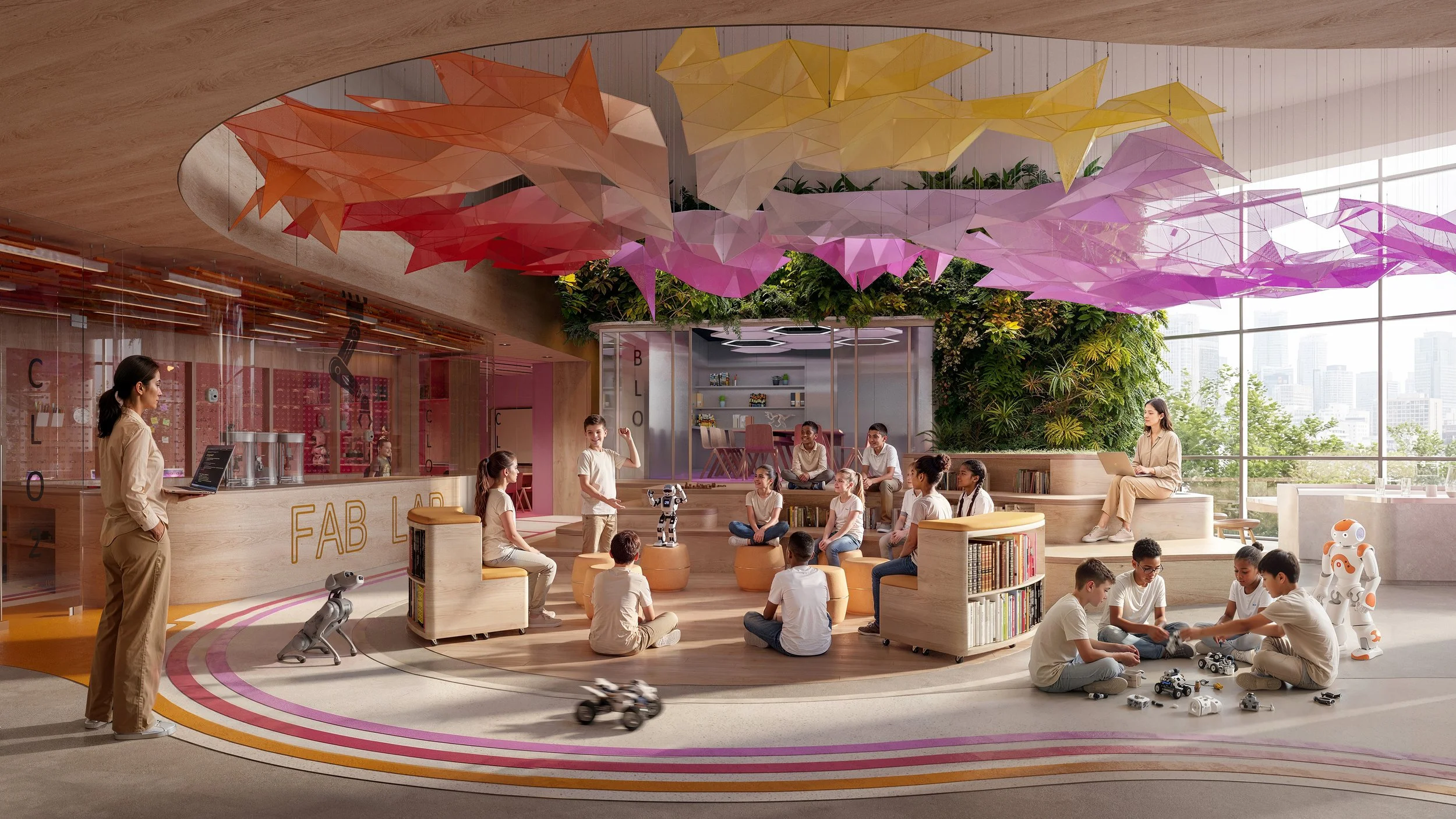
The future belongs to the kids who fidget, who ask the questions not yet asked. The Makers of Our Future playground is designed for the wonder of children exploring the boundaries of possibility.
The animation follows the life of the lab rather than its rooms: children, teachers, and robots moving through a day together. Each scene finds the space configured differently, evidence of an architecture that adapts without announcing it. Among the occupants is a new kind of resident. Robots are not equipment stored between lessons but classmates in circulation, learning as they are taught. The film captures the project's central proposition: a building designed for the first generation to grow up sharing space with another form of intelligence.
The FabLab forms an adaptive environment where children learn to craft physical AI and synthetic biology. Intensive programming with global innovators produced new courses in fabrication, coding, and inquiry-based learning. Forming an exoskeleton for the mind, the courses position AI as the baseline upon which critical thinking builds.
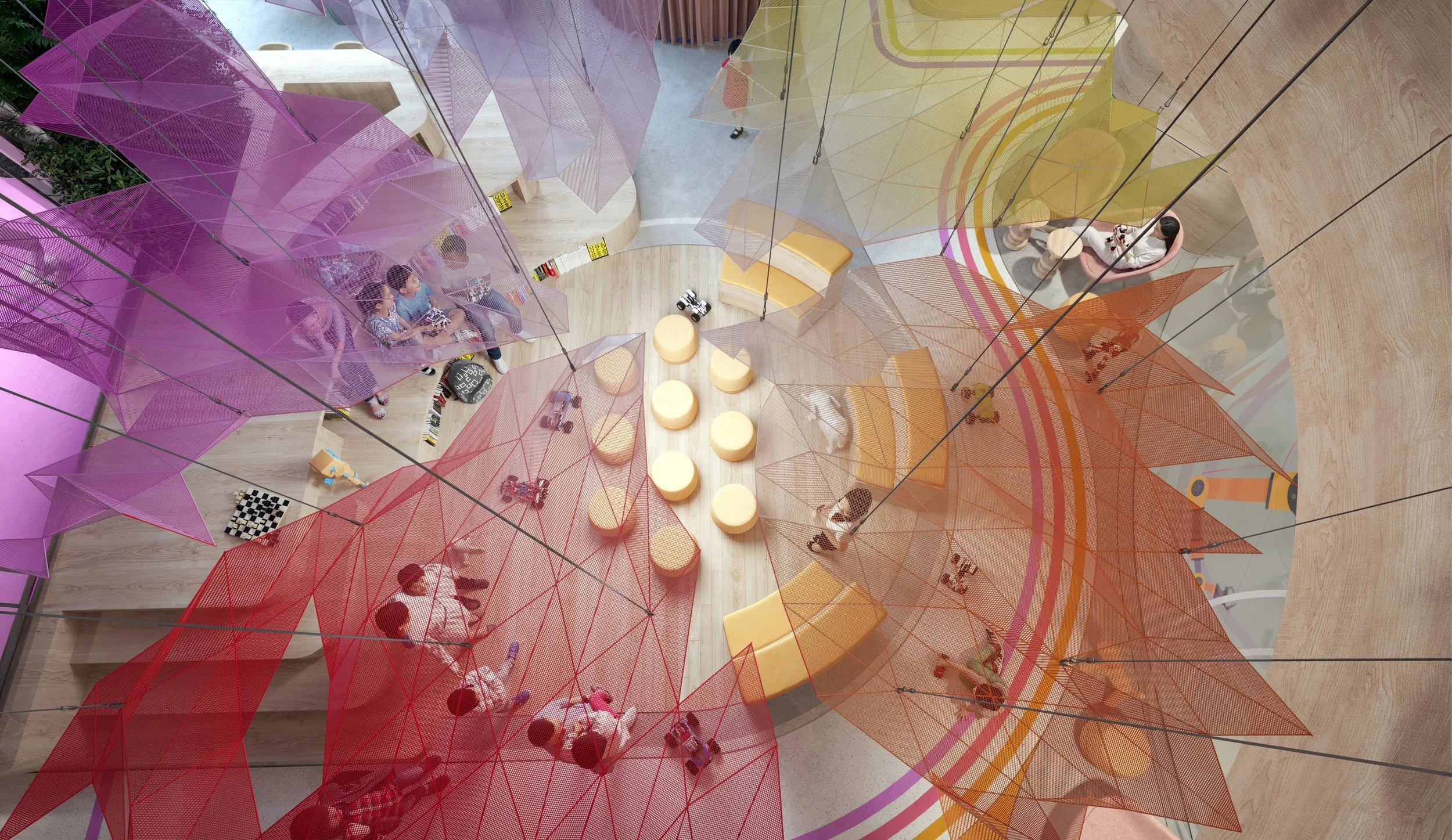
At the center, a kinetic temporal cloud activates each hour: wayfinding, spatial activator, and clock, marking time as a spatial event. Nothing in the space is fixed. All furniture moves, rolls, or slides, enabling pedagogy without physical or mental boundaries. Spaces are organized as a gradient, from open and public at the center to private and quiet at the edges.
The central space acts as a catalyst for activity while remaining flexible. The purple flex lab serves cafe guests and waiting parents at open tables, then hosts lectures when the curtains draw closed. Lines in the floor guide each student from check-in to their lab.
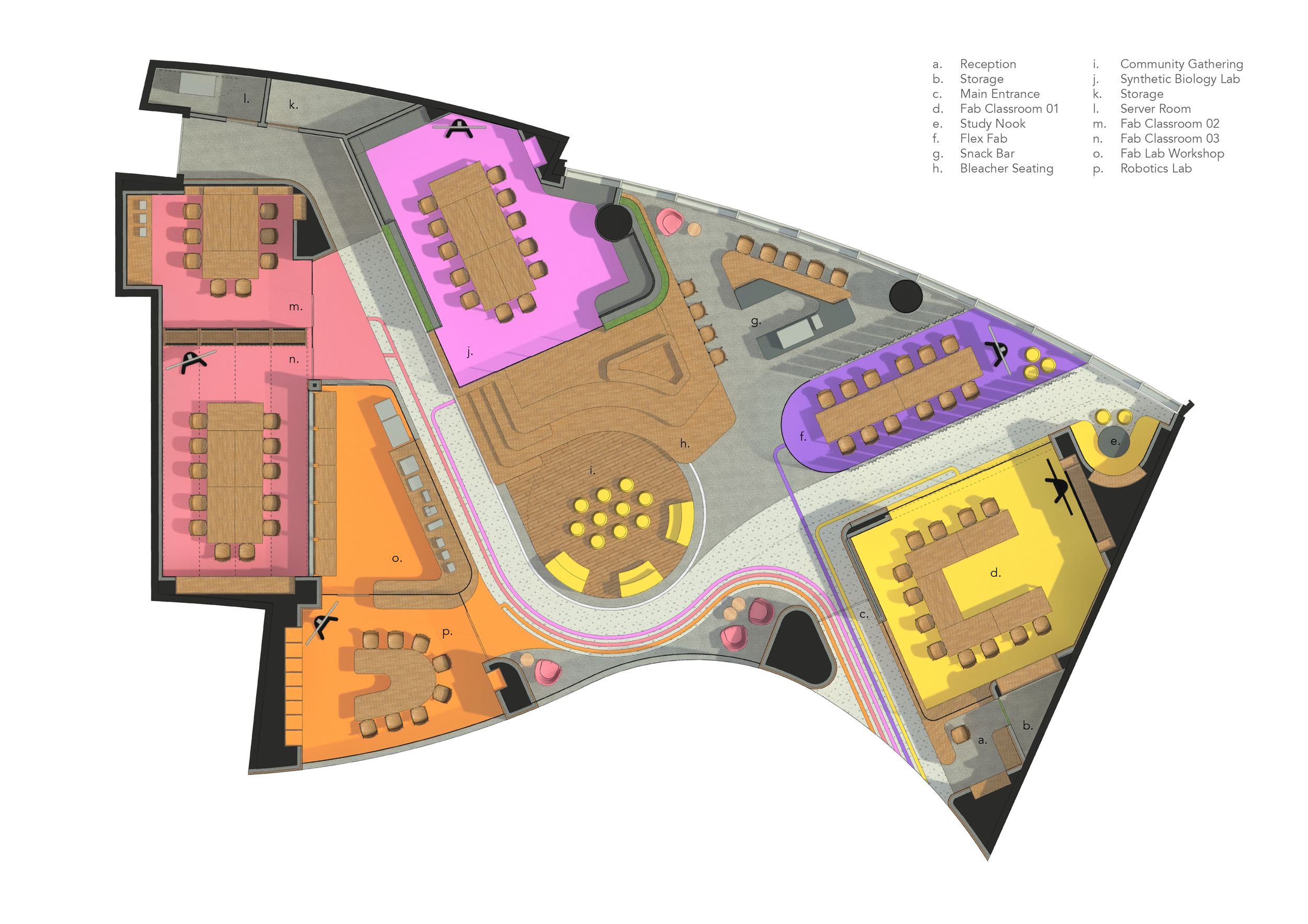
The Kinetic Temporal Cloud is a working object, not a ceiling sculpture. Each hour on the hour it dances across the ceiling, marking time as a spatial event. Its colors organize the room below, each hue pointing toward its matching lab classroom, wayfinding and spectacle in a single system.
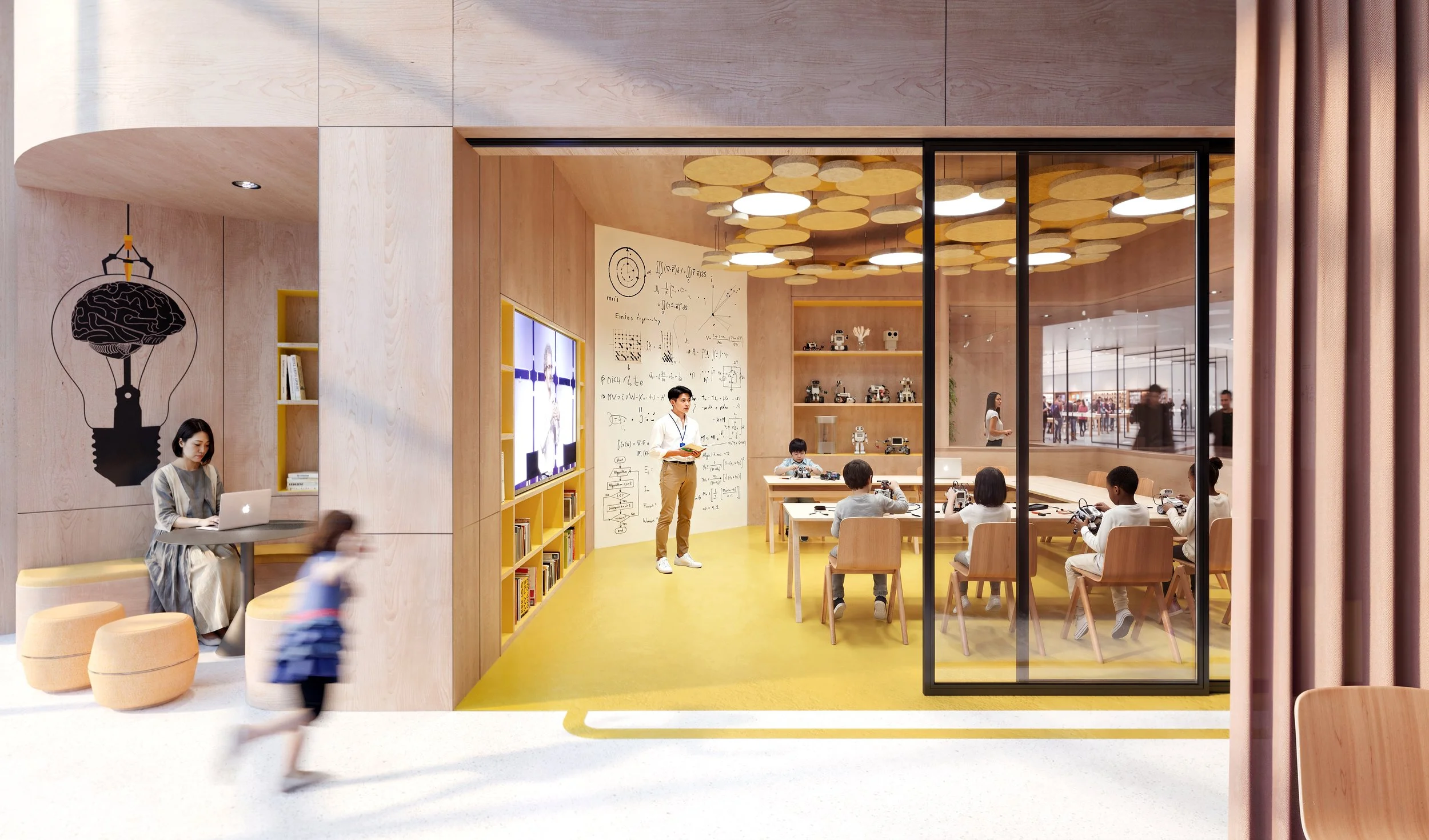
Tucked beside the reading nook, an adaptive lecture space uses folding doors to open onto the main room or close for acoustic privacy during lectures and testing. Every table is designed to transform across configurations: community tables, individual desks, and U-shaped lecture seating.
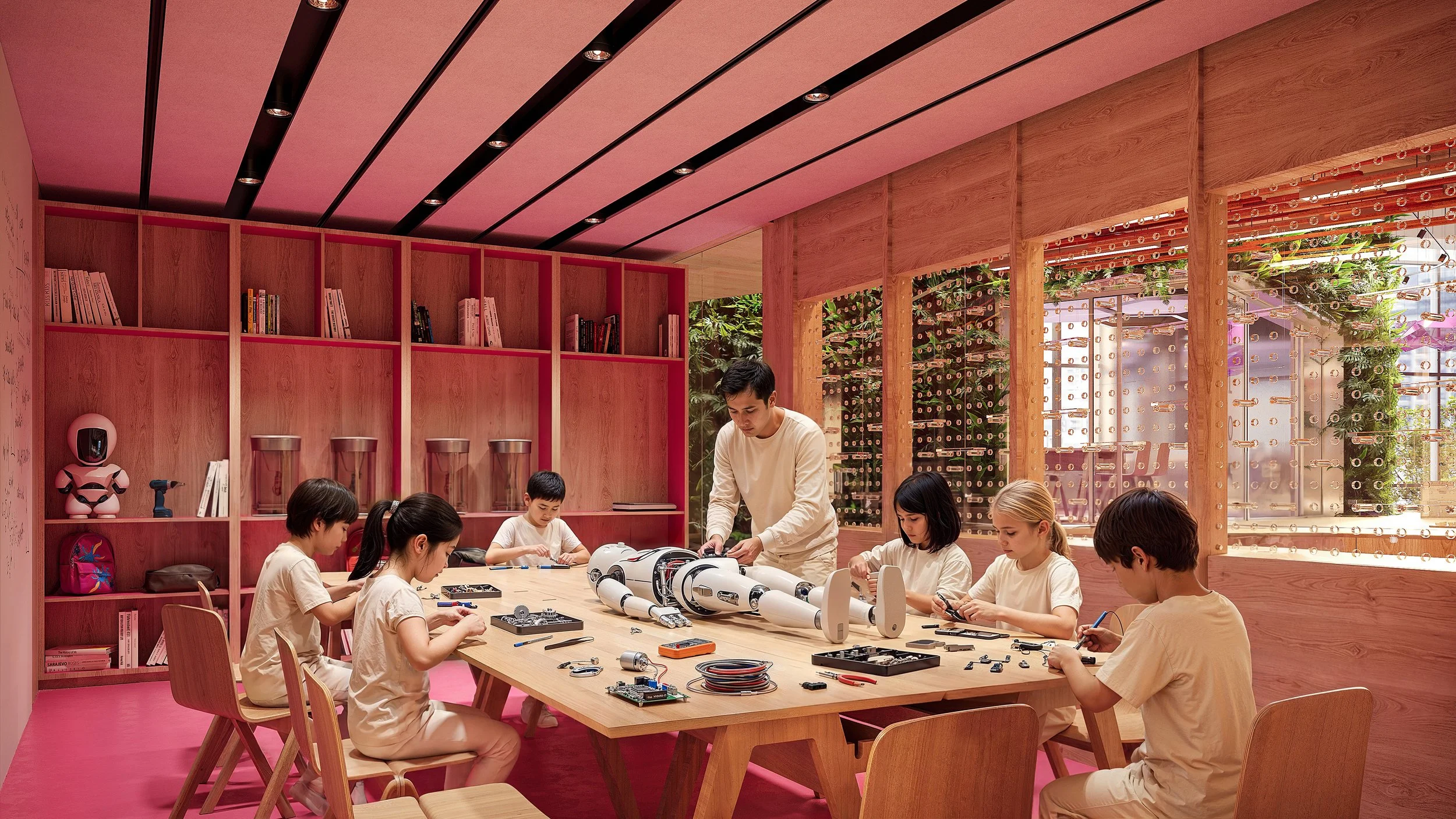
An adaptive space with moving bookshelves linked to the tracks in the ceiling, they configure the maker lab for each event. In the maker lab, the class assembles a robot alongside the teacher. Later they will train it together, building its cognitive functions beginning with epistemological and ontological reasoning. To train another being, students must first identify their own beliefs. Teaching the machine sharpens their own worldview.
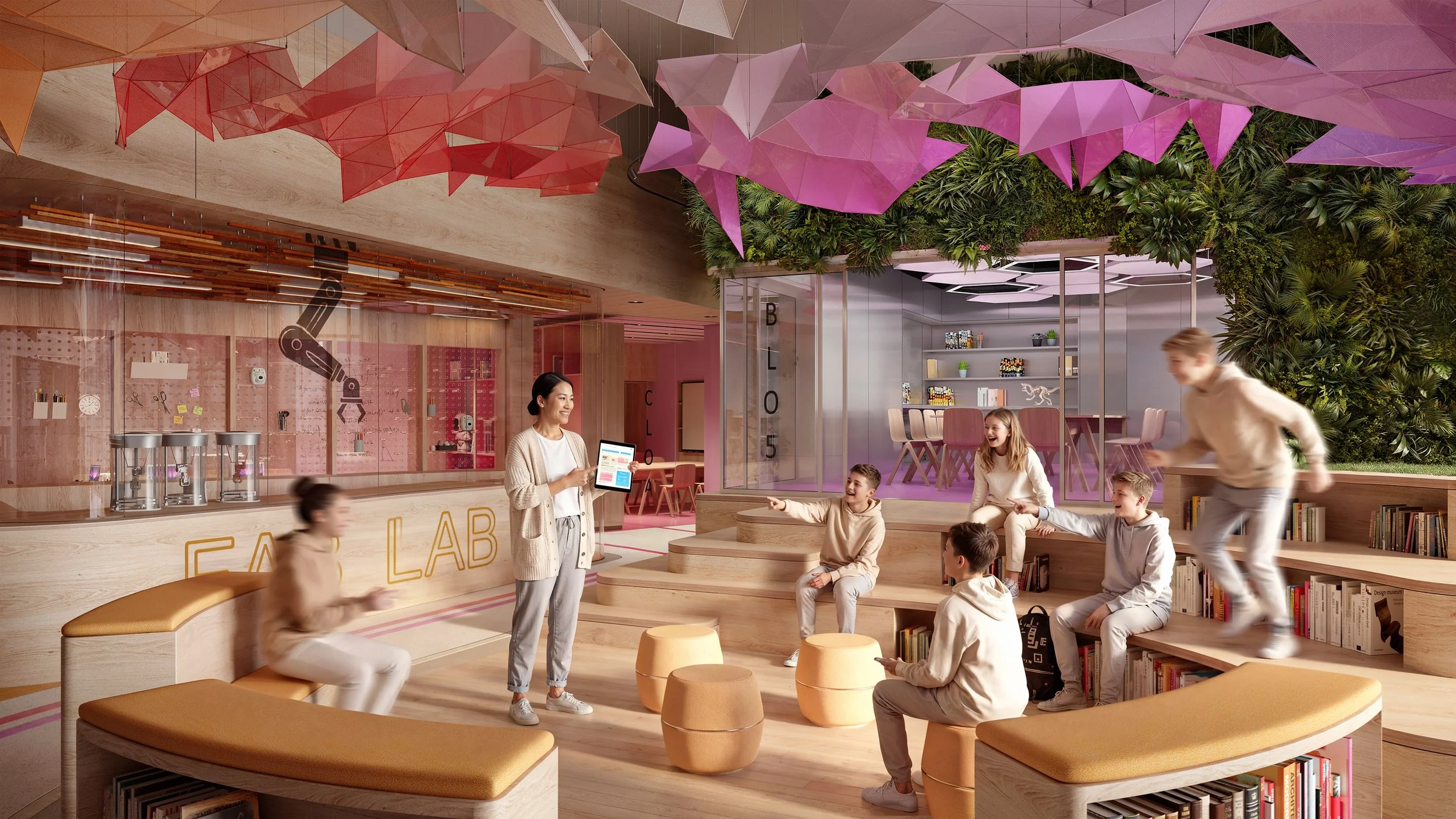
Sharing and collaboration is a cornerstone of the pedagogy. Beneath the kinetic temporal cloud, a group of children share what they have been building in class and in the FabLab. The central bleacher seating doubles as presentation space and the FabLab's library. Rolling bleachers and stools reconfigure quickly for each activity. As the heartbeat of the project, the space stays open and visible, so every presentation becomes something the whole lab learns from.